
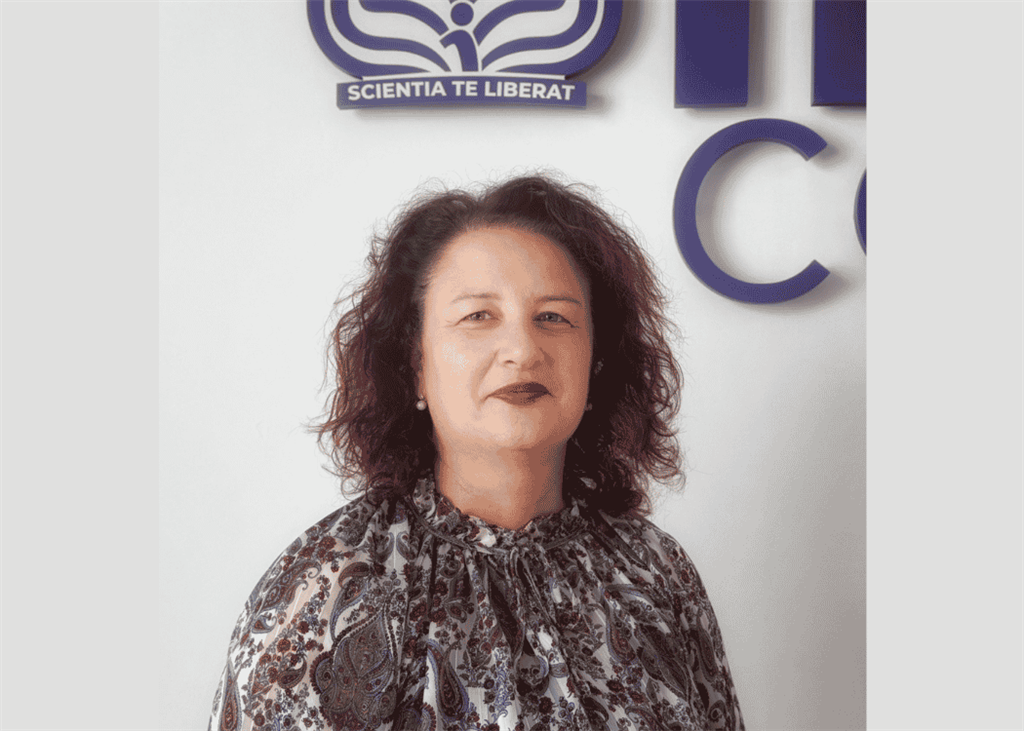
Not everyone who joins an education institution is chasing status. Some are chasing answers. Dr. Sonia Galea, Deputy Principal of IDEA College, has spent her career asking one question above all others: what does it actually take to make education work for everyone, not just the students who arrive already prepared to succeed?
“Listening to our students, understanding their difficulties, guiding them in the best way possible so as to help them reach their goal, these are at the core of my beliefs here at IDEA.” - Dr. Sonia Galea, Deputy Principal, IDEA College
Dr. Galea’s doctoral research, completed at the University of Sheffield, examined what makes an inclusive school in the Maltese context, drawing on interviews and surveys across schools in Malta and Gozo. The findings were candid: most stakeholders believe in inclusion and try hard to implement it, but report worry and frustration around mixed-ability classes, learners with multiple needs, gifted students, and international students. The recommendations pointed to clearer policy, better educator training, more human resources, and revised syllabi, the findings of a researcher willing to look directly at where the system is falling short, and to say so.
That orientation toward students who are not being adequately served has personal roots. “As a student, I found support to be a crucial aspect throughout my academic journey,” Dr. Galea recalls. “However, there were still times where I felt that proper academic support was lacking, which led me to search for support from other professionals outside of my institution. These individuals proved to be a source of inspiration in the holistic support which I offer to our students.” The support model she now leads at IDEA was shaped, in part, by knowing exactly what it feels like when a system does not catch you.
Before IDEA, Dr. Galea’s applied research at MCAST focused on the students for whom mainstream education had not worked: vocational and further-education learners, NEETs (young people not in education, employment, or training), and students navigating the disruptions of the COVID-19 pandemic. The patterns across her studies were consistent: students wanted more individualised support, clearer career guidance, and help building self-confidence and foundational skills.
Read those findings in the context of IDEA College’s mission and the connection is immediate. The students Dr. Galea has spent years studying, disengaged, uncertain, in need of guidance rather than just instruction, are precisely the students IDEA College is designed to serve. She did not arrive as an outsider. She arrived as someone who had spent years building the evidence base for why institutions like it are necessary.
The three intellectual pillars of Dr. Galea’s doctoral work - inclusive leadership, Universal Design for Learning, and professional learning communities, map directly onto the kind of institution IDEA College aspires to be. Universal Design for Learning insists on building flexibility into education from the beginning: designing programmes that do not require students to disclose a difficulty in order to access support, but that are structured, from the outset, to accommodate different ways of learning.
For an institution serving adult learners from 16 nationalities, across more than 12 fields of study, in both campus-based and hybrid delivery formats, that is not an abstract ideal. It is operational reality.
At IDEA College, Dr. Galea’s research instincts are turned outward into operational leadership. Asked what core beliefs drive her direction of the Student Support Department, she does not begin with frameworks or policy citations. She begins with the work itself.
“We spend a lot of time over the phone communicating with our students, listening to them and empathising with any physical, psychological or social difficulties they may be going through,” she says. “Ultimately, I need to lead by example and also support my team in carrying out this particular function, which is very taxing psychologically and on an emotional level.”
That is an unusually honest sentence from a senior academic leader. It acknowledges that support work, when done properly, is hard, and that the people doing it need their own support in turn. It is also a leadership ethos that takes inclusion out of the realm of slogans. “At the core of my beliefs is also inclusive education,” she continues. “One of the identifying principles of IDEA College is the inclusion of all students with regards to culture, sex, religion, language, amongst other differences.”
Asked what single radical change she would make to the education system, her answer is characteristically practical: address the transversal-skills gap. “Research is indicating that employers are facing particular challenges when their employees lack skills, particularly critical thinking, problem-solving skills, communication skills, and resilience,” she explains. “More focus on these through experiential learning is needed at any level, starting from an early age.”
What does that philosophy look like in practice? IDEA College runs free cyclical workshops covering brainstorming and research skills, academic writing, presentation skills, plagiarism, AI use and misuse, and dissertation work. “Academic writing has always proved to be challenging for some of our students,” Dr. Galea notes, and the workshop programme grew directly out of that observed demand. One-to-one support runs alongside, and where students are identified as struggling to balance work and study, the team designs a tailored study plan rather than leaving them to manage the conflict alone.
Dr. Galea is also directly involved in supporting students through their dissertations, an unusual hands-on commitment for a Deputy Principal, and one she sustains by deliberately keeping current with innovative research methods so as to guide students effectively in both their proposals and dissertations.
Inclusivity at IDEA, she emphasises, “includes catering for those students who do not necessarily have an educational background, or students who have not studied in a long time”, a point that will resonate with agents whose clients are adult learners returning to study after years away, or first-generation higher-education entrants. Career readiness is built in via lecturers chosen for their industry experience, work placements where relevant, and simulated practice. Community is sustained through the Alumni network and the “research café,” a forum where academics and students working on dissertations come together to discuss the studies, challenges, and transversal skills involved in any research journey.
“We value support in its widest sense and believe that it is not unidirectional. Through the community of practice, support is multiplied, and empowerment is enhanced.”
- Dr. Sonia Galea
For education agents placing students with IDEA College, the leadership team matters, and Dr. Galea’s profile addresses a question agents are increasingly asked: is this institution genuinely equipped to support students who may need more than standard classroom delivery?
The answer is grounded in both peer-reviewed research and on-the-ground operational detail. Dr. Galea has translated years of evidence into a support architecture that names what students actually need: academic writing help, dissertation guidance, study planning, mental health awareness, career exposure, and a community that does not end at graduation. When IDEA College makes claims about supporting diverse learners and building pathways for students who haven’t always thrived in conventional settings, there is a researcher at the leadership table who has spent years examining whether those claims hold up, and who is now responsible for ensuring they do.
What is striking about Dr. Galea’s account of the work at IDEA is how steadily it refuses the heroic frame. Support is not delivered to students from above; it is built with them, sustained by a team that itself needs care in order to give it, and extended into a community that continues past graduation. “We are all on this journey together,” she says of the model, “so we all grow together.”
For students considering Malta as a study destination, and for the agents who advise them, that combination of rigorous scholarship, operational seriousness, and a leader who is honest about how hard the work actually is, is exactly what credible, modern higher education looks like.











2026 SchoolsandAgents (C) - Developed by Lunarsors