
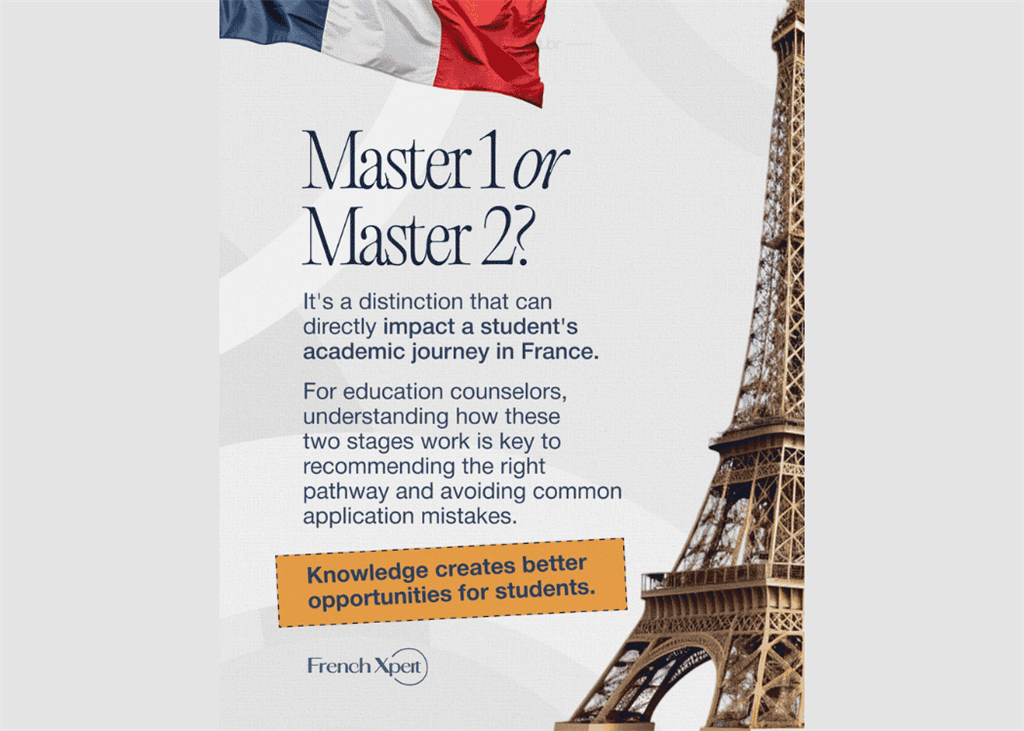
When advising students who are considering postgraduate study in France, one small detail can make a significant difference to their entire application strategy: knowing whether they should apply for a Master 1 or a Master 2.
For international education counsellors, understanding this distinction is essential. The French Master’s degree is not simply a two year programme where students can choose to enter at either level. Master 1 and Master 2 represent two different stages of the same academic cycle, with different admission expectations.
For students coming from Brazil in particular, getting this right can help avoid unsuitable applications, unnecessary rejections and delays in finding the right academic pathway.
Master 1, commonly referred to as M1, is the first year of the French Master’s cycle.
For a student who has completed a Brazilian Bachelor’s degree, M1 is generally the appropriate entry point when progressing to postgraduate study in France.
The first year is designed to build advanced academic knowledge and develop the foundations needed for further specialisation. Depending on the subject and institution, students may study a broad range of modules before moving towards a more defined area of expertise in their second year.
For education counsellors, this is an important point to communicate clearly to students. Having completed an undergraduate degree does not automatically mean that a student should apply directly to the final year of a French Master’s programme.
Master 2, or M2, is the second and final year of the French Master’s cycle.
At this stage, students typically move towards greater specialisation. Their studies may place a stronger emphasis on research, professional practice, a dissertation, an internship or other forms of advanced academic and professional development.
Admission to M2 is therefore different from admission to M1.
Direct entry into Master 2 is generally intended for candidates who already have an academic background equivalent to the first year of a French Master’s programme. This may include students with additional postgraduate qualifications or candidates whose previous studies and relevant professional experience demonstrate that they are ready to enter at this advanced level.
This is why a student with only a Brazilian Bachelor’s degree should not automatically be directed towards M2.
For international education agents and counsellors, recommending the correct entry level is about much more than completing an application form correctly.
A student applying to the wrong level may face rejection even when they are academically strong. In some cases, the issue is not the quality of the student's profile, but simply that their previous qualification does not correspond to the level of study for which they have applied.
Understanding the French higher education structure allows counsellors to have more informed conversations with students about their academic background, qualifications and long term objectives.
It also helps set realistic expectations.
Rather than asking simply, "Which Master’s course do you want to study?", counsellors should consider questions such as:
These questions can make the difference between recommending a realistic pathway and submitting an application that is unlikely to succeed.
For students and their families, the distinction can initially seem confusing.
A useful way to think about the French Master’s structure is:
Master 1 = first year of the Master’s cycle
Master 2 = second year of the Master’s cycle
For many students progressing from a Brazilian Bachelor’s degree, M1 will therefore be the natural starting point.
M2 is not simply another option alongside M1. It is the advanced second year of the cycle, meaning that institutions need to be confident that a student has already completed the equivalent academic preparation.
This distinction is particularly important when students are comparing French universities with higher education systems in other countries, where postgraduate structures and entry requirements may work differently.
One of the biggest advantages of understanding M1 and M2 is the ability to screen applications more effectively before submission.
An experienced counsellor can identify whether a student's academic history appears aligned with the requested level and then seek clarification from the institution where necessary.
This can save valuable time for everyone involved.
It also creates a better experience for the student. Being rejected because an application was submitted at the wrong academic level can be frustrating, particularly when the student may have been perfectly suitable for M1.
The goal should always be to match the student's existing qualifications with the appropriate stage of the French higher education system.
The M1 and M2 distinction can also help counsellors think about the student's longer term academic journey.
A student entering M1 is not simply starting another postgraduate course. They are beginning the first stage of a structured Master’s cycle that can lead towards more specialised study in M2.
This gives counsellors an opportunity to discuss the student's objectives from the beginning. Are they interested in research? Do they want to develop a professional specialisation? Are they hoping to continue towards further postgraduate study? Or are they looking to gain specific skills that will support their career?
Understanding where M1 fits within the wider journey can make those conversations much more productive.
The French higher education system offers excellent opportunities for international students, but its structure and terminology can be unfamiliar to students and counsellors working with different education systems.
For education agents, having a clear understanding of distinctions such as M1 and M2 is therefore an important part of providing accurate guidance.
At FrenchXpert, we help partner agencies navigate the French higher education system with greater confidence and precision, supporting counsellors as they guide students towards appropriate study pathways in France.
For more information, visit FrenchXpert at www.frenchxpert.com.













2026 SchoolsandAgents (C) - Developed by Lunarsors