
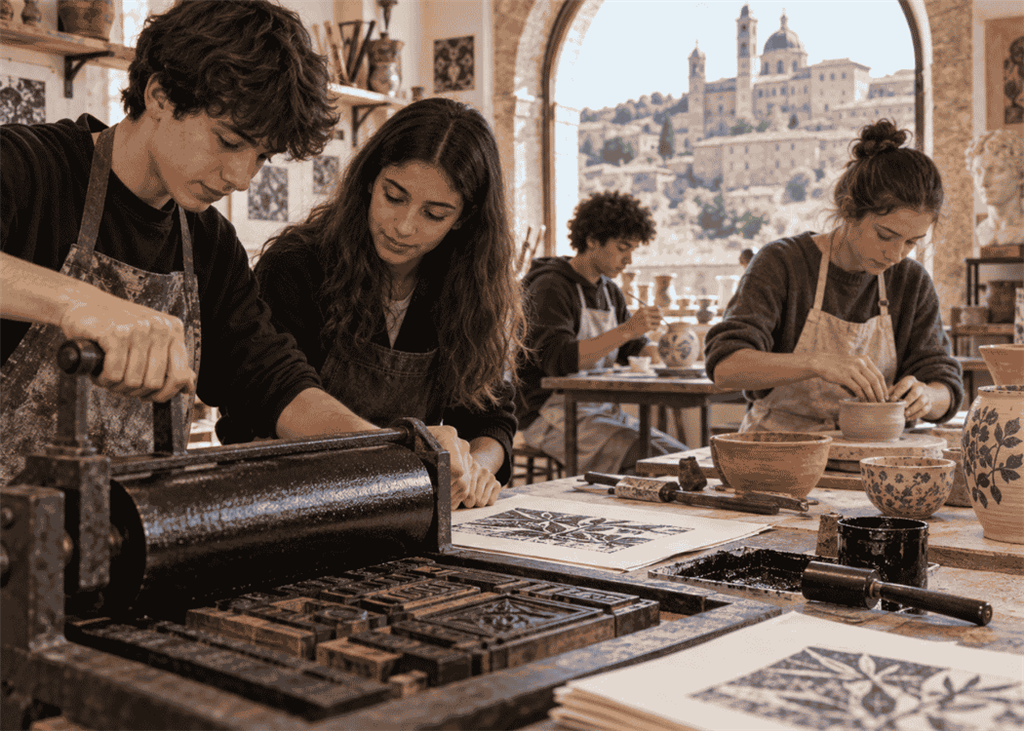
A traditional printing press, a piece of linoleum ready to be carved, or a block of clay waiting to take shape can teach students lessons that are difficult to recreate in an ordinary classroom. At La Corte della Miniera and Museum Graphìa, the International Museum of Printing in Urbino, students are invited to become active participants in the creative process, developing practical abilities while exploring the relationship between artistic expression, cultural heritage and professional practice.
Designed for school groups, these programmes combine preparation in the students’ home institution with an intensive practical experience in Italy. They are particularly relevant to agents working with secondary schools, international schools, art colleges and other institutions seeking educational travel programmes with clear learning objectives.
The guiding principle behind La Corte della Miniera’s educational approach is simple: students learn more deeply when they are given the opportunity to participate. Rather than treating educational travel as a series of passive visits, the programmes place students inside working creative environments where they can observe professional processes, use specialist equipment and produce their own work.
The experience connects classroom learning with practical application. Students consolidate knowledge acquired at school while developing technical, organisational and creative skills that can be applied within further education or a future professional setting. Activities can include classroom preparation, observation of production processes, meetings with experts, individual project development and participation in the normal workflow of the host organisation.
La Corte della Miniera works directly with schools to plan each learning pathway. This collaborative approach allows the programme to complement the institution’s curriculum and respond to the students’ particular subjects, abilities and educational objectives. The school remains responsible for evaluating the experience and incorporating it into each student’s educational record where appropriate.
The programmes take place at La Corte della Miniera and Museum Graphìa, the International Museum of Printing associated with the centre. This gives students access to a setting where history, craftsmanship and contemporary creative practice meet.
Urbino provides an equally valuable context for the experience. Internationally recognised for its Renaissance heritage and artistic traditions, the city allows schools to connect practical workshops with wider studies in art, history, architecture and Italian culture. This combination can make the programme especially appealing to schools looking for a more focused alternative to a conventional tour of Italy.
La Corte della Miniera states that it provides suitable spaces, specialist equipment and professional support for the planned activities. The organisation is registered with Italy’s National Register for School and Work Programmes and provides an external training tutor to support students throughout the practical element of the course.
The “Graphìa: original art printing” programme examines the history and expressive possibilities of the printed image. Students learn how signs, symbols and forms of writing have developed across different historical and cultural contexts before using traditional and contemporary printing methods to express their own ideas.
The course introduces typography, woodcut, intaglio printing, lithography and screen printing. Its objectives include helping students understand the principal elements of visual and graphic language, identify suitable artistic techniques and manage the development of a personal creative project from its initial concept to the finished piece.
During the letterpress workshop, students work inside a traditional printing environment using wooden movable type, ink and manual presses. Each participant designs and prints an individual artistic poster, gaining direct experience of the decisions and processes involved in producing printed work.
The woodcut workshop explores relief printing. Students learn about the origins and visual characteristics of the technique before engraving a modern linoleum surface that is suitable for manual printing. This allows them to experiment with strong lines, simplified images and the relationship between the carved surface and the final print.
Students can also study sustainable drypoint engraving on plexiglass. Beginning with a personal design, they use points, tools and abrasive papers to create different marks and textures before printing their work with an intaglio press. The activity introduces the principles of direct engraving while encouraging greater awareness of materials, methods and safer creative practices.
Further workshops cover lithography and toner transfer, bringing together traditional stone lithography and more recent processes involving digital graphics. Screen printing activities allow students to create designs for handmade fabric items such as shirts and bags. Natural fabrics and non toxic inks are used to explore how this popular creative technique can be practised with greater consideration for the environment.
A second pathway focuses on sculpture, modelling and ceramic decoration. This programme gives students the technical foundations needed to produce ceramic and terracotta objects through drawing, modelling, shaping and decoration.
Participants work with methods that can include coil building, the potter’s wheel, surface decoration and fresco techniques. They learn how to select and adapt materials, tools and machinery according to the intended result. Alongside these practical abilities, the course develops the organisational skills needed to plan and complete an individual three dimensional clay project.
The programme also explores the place of sculpture within contemporary creative work. By understanding how sculptural forms and techniques have developed throughout history, students can consider how traditional knowledge continues to influence present day artistic and professional practice.
Working with clay encourages patience, close observation and problem solving. It also gives students a shared creative language through which they can communicate, listen to one another and recognise different approaches to the same task. These qualities make the programme relevant not only to students already specialising in art, but also to schools seeking an educational experience that supports confidence, cooperation and personal expression.
The original art printing pathway includes ten hours of preparatory training at the school, followed by six days and five nights at La Corte della Miniera, with a total of thirty hours of practical training in Urbino. The sculpture and ceramics pathway follows the same residential format and includes thirty two hours of practical training.
Schools may also request an additional three hour preparation and development session delivered by one of La Corte della Miniera’s technicians at the participating institution. This can help students understand the programme before travelling and arrive in Urbino ready to make full use of their workshop time.
The programmes can accommodate groups of between fifteen and seventy students. Agents can therefore discuss options for individual classes, subject departments or larger school groups, depending on the institution’s requirements.
These programmes are particularly well suited to secondary schools, international schools, boarding schools, vocational institutions and specialist art colleges. They can also appeal to schools offering subjects such as fine art, graphic design, visual communication, textiles, fashion, ceramics, history, Italian studies and cultural heritage.
Agents working in the United Kingdom, Ireland, Germany, Austria, Switzerland, France, Belgium, the Netherlands, Spain, Portugal, Central Europe and the Nordic countries may find strong potential among schools that already organise cultural visits and curriculum based educational travel. The programmes may also interest selected schools in the United States and Canada, particularly when Urbino is included within a longer Italian study tour.
For agents, the main advantage is the clarity of the educational content. The experience can be presented as a structured creative programme with practical outcomes, professional guidance and a close connection to the participating school’s curriculum. Students do not simply observe Italian art and craftsmanship. They work with the techniques, materials and equipment themselves, leaving Urbino with completed projects and a stronger understanding of the processes behind them.
La Corte della Miniera offers schools the opportunity to combine cultural discovery with purposeful learning in one of Italy’s most important artistic cities. For agents seeking original programmes for creative school groups, it provides a credible alternative to the standard educational tour and gives students a genuine reason to engage with the destination.
Get in touch with the organisation here for further info and collabs.









2026 SchoolsandAgents (C) - Developed by Lunarsors