
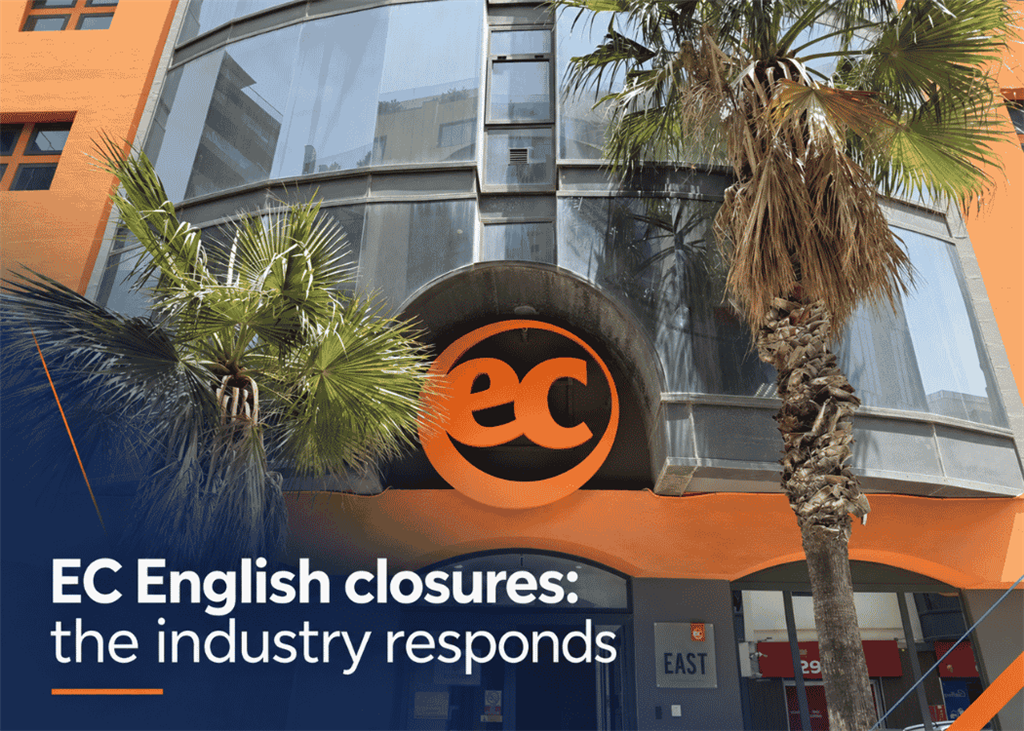
News that EC English is closing schools across several major study destinations has sent shockwaves through the international education community. After 35 years in language education, EC had become one of the sector’s most recognisable names, building relationships with students, agents and industry partners around the world. Its closure is therefore more than the loss of a familiar school group. It is a difficult moment for everyone directly affected and a sobering reminder of the pressures currently facing international education.
The first concern must be the students whose courses have been interrupted, followed closely by the staff members who have lost their jobs and the agents who are now helping clients understand what happens next. In the United Kingdom, Canada and Malta, industry associations and schools have moved quickly to coordinate support, identify alternative study places and provide students and their families with clearer information.
Their response demonstrates the practical value of strong national associations, established student protection arrangements and cooperation between schools. At the same time, the scale and international reach of these closures should encourage a much broader conversation about the health of the language education sector.
English UK has activated its Student Emergency Support scheme following the closure of EC English schools in London, Cambridge, Brighton and Manchester. The association expects to help approximately 370 students who were already enrolled at these four locations complete their courses at other English UK member centres without paying additional tuition fees.
Jodie Gray, Chief Executive of English UK, described the announcement as “extremely difficult news” for students, employees, agents and partners. She also stressed that the association’s immediate priority is to support affected students and help them continue studying with as little disruption as possible.
English UK is coordinating placements centrally, rather than asking students or agents to approach individual schools. Member centres are providing details of available spaces, course types, locations, possible starting dates and any relevant restrictions. This allows the association to consider each student’s circumstances and match them with an appropriate alternative in a fair and orderly manner.
The distinction between current and future students is important. English UK’s Student Emergency Support scheme is focused on eligible learners who had already started their courses at EC’s British schools. Students with future bookings are being advised to monitor communications from EC and remain in contact with their education agents. English UK’s full statement provides further guidance for students, agents and member centres.
Languages Canada is supporting approximately 375 students enrolled at EC English schools in Toronto and Vancouver, together with around 40 students affected by the previously announced closure of the Montreal location. The association is also addressing the needs of students with upcoming bookings at EC’s Canadian schools.
Under the Languages Canada Quality Assurance Framework, tuition is protected through its Education Completion Assurance Plan. In most cases, this protection is provided by placing affected students in a similar programme at another accredited member institution. More than 25 member programmes had already offered to receive displaced students by 14 September, with further offers continuing to arrive.
Languages Canada has prioritised students whose courses are due to finish within two weeks, allowing them to complete as much of their original programme as possible. It has also confirmed that students insured through guard.me in connection with their EC studies will continue to receive insurance coverage.
The organisation placed the closure within a wider sector context, noting that language education suffered severely during the COVID 19 pandemic and has subsequently faced political and policy environments that have made international mobility increasingly difficult in several leading destinations. Its statement calls this “a difficult day for the global language education community” and confirms that advocacy for greater stability, confidence and growth will continue. The Languages Canada statement is being updated as the placement process progresses.
In Malta, the Federation of English Language Teaching Organisations Malta has confirmed that EC English Malta will close after more than 30 years of operation. FELTOM acknowledged the significance of the announcement for the students, employees and wider English Language Teaching community while making the needs of current students its immediate priority.
FELTOM member schools are working together to accommodate affected learners and allow them to continue attending English lessons. The federation will coordinate the allocation of students across participating schools, with support from Alpha School of English, AM Language, BELS Gozo, BELS Malta, Berlitz English Language Academy, Cavendish School of English, Clubclass English Language Campus, Easy School of Languages, European School of English, IELS, inlingua School of Languages, NSTS English Language Institute and Sprachcaffe Languages Plus.
FELTOM is also maintaining contact with EC, the ELT Council and the relevant authorities throughout the transition. Its closing message is simple but significant: Malta’s schools are working together, students remain the priority and the sector stands together.
This coordinated action reflects the close relationships within Malta’s ELT community. Schools that would ordinarily compete for international students are now sharing responsibility for protecting learners and preserving confidence in Malta as an English language destination.
Behind the enrolment figures are students who travelled to another country expecting education, accommodation and support for a defined period. Some may be approaching examinations or preparing for further studies, while others may have organised employment leave, flights and family commitments around their courses. Even where another school can provide an equivalent programme, an unexpected transfer can still be unsettling.
Agents are likely to become one of the principal sources of reassurance during this period. They will be helping students interpret communications, understand the difference between current and future bookings and navigate questions involving accommodation, insurance, refunds and alternative courses. Clear, consistent updates from associations and school groups will be essential if agents are to give families accurate guidance.
The effect on EC employees must also remain part of the industry conversation. Teachers, admissions professionals, marketers, accommodation teams, centre managers and student welfare personnel have all contributed to EC’s presence over several decades. Many will now be dealing with sudden professional and personal uncertainty while also helping students through the transition.
The closure of such a prominent organisation will inevitably lead to questions about the wider condition of the sector. One company’s circumstances should not be used to make unsupported assumptions about every school or destination, but neither should the announcement be treated as an isolated piece of business news.
International education providers have endured years of disruption, rising operating costs and uneven recovery. In several destinations, visa changes and shifting government rhetoric have also made international students feel less certain or less welcome. Schools must plan staffing, property, accommodation and marketing well in advance, yet political decisions can alter demand with very little notice.
Agents face similar pressures. When a large provider closes, agencies must manage the consequences with students even when they have had no influence over the decisions involved. This can affect their workload, cash flow and reputation in local markets. Greater transparency between schools and agents is therefore important throughout the normal booking cycle, not only when a crisis has already emerged.
The announcement should prompt schools, agencies and associations to review how student funds are protected, how rapidly concerns are communicated and what contingency arrangements exist when a provider can no longer deliver a booked course. Commercial confidence matters, but silence or uncertainty can cause greater reputational damage once students begin asking questions.
The responses from English UK, Languages Canada and FELTOM provide an important counterpoint to the uncertainty. These organisations are not simply issuing messages of sympathy. They are coordinating alternative placements, gathering information, communicating with agents and mobilising member schools to protect students.
This is precisely where membership structures, accreditation requirements and emergency support arrangements prove their worth. Quality assurance is not only about academic standards or inspection reports. It also concerns what happens when normal operations fail and whether students have somewhere credible to turn.
The willingness of competing schools to offer places is equally encouraging. It reflects an understanding that confidence in a study destination depends on the behaviour of the whole sector. Supporting an affected student today protects more than one enrolment. It helps preserve trust among families, agents and international partners who will remember how the industry responded when circumstances became difficult.
EC English has played a considerable role in international language education, and its departure will be felt across numerous markets. There will be time to examine the commercial and policy circumstances surrounding the closures more closely. For the moment, however, students need practical answers, employees deserve consideration and agents require reliable information that they can pass on to their clients.
The response so far has shown international education at its most collaborative. Associations have activated support systems, schools have offered capacity and industry professionals are working across organisational boundaries. That solidarity does not remove the seriousness of what has happened, but it does demonstrate that the sector possesses both the structures and the willingness to respond.
Once the immediate student placements have been addressed, the industry must continue the conversation. The closure of a group with EC’s history and international reach should lead to careful reflection on resilience, policy, student protection and the future shape of language education. The strongest tribute to the students, employees and partners affected will be a sector that learns from this moment and becomes better prepared for whatever comes next.













2026 SchoolsandAgents (C) - Developed by Lunarsors